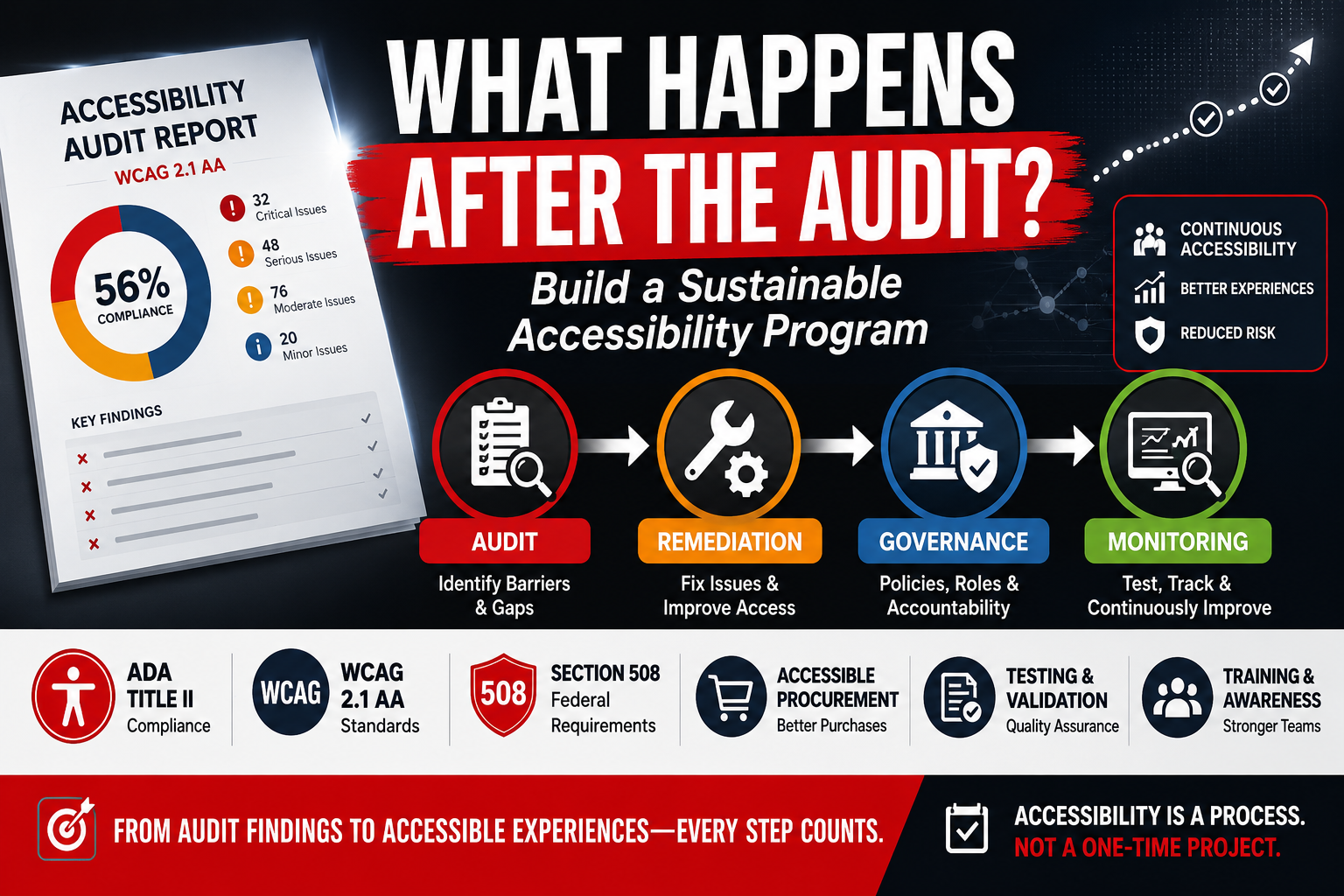
Many organizations have completed accessibility audits, documented accessibility defects, and developed remediation plans.
These are important steps.
However, one question often remains unanswered:
What happens when someone encounters a new accessibility barrier after the audit is complete?
Perhaps an employee using a screen reader cannot access a recently purchased application. A resident may be unable to complete an online government form. A student may receive an inaccessible spreadsheet. A customer may report that a mobile app cannot be operated with a keyboard or assistive technology.
Without a defined process, these concerns may be passed between departments, placed in a general support queue, or left unresolved.
This is why accessibility help desks and clearly defined program teams are becoming increasingly important.
Accessibility Is an Ongoing Service
Accessibility is sometimes treated like a temporary project.
An organization hires a consultant, performs an audit, fixes a selection of issues, and considers the work complete.
But digital environments constantly change.
Teams publish new content. Developers release software updates. Departments purchase new tools. Vendors modify their platforms. Employees create documents, presentations, spreadsheets, videos, and online forms.
Every change creates the possibility of a new accessibility barrier.
An organization therefore needs a reliable way to receive, investigate, assign, resolve, and track accessibility concerns.
Recent Section508.gov guidance describes an accessibility help desk as a centralized and accountable process for reporting barriers, delivering expert guidance, coordinating remediation, and supporting compliance.
The help desk may operate independently or be integrated into an existing information-technology support desk.
The important point is that users know where to go—and the organization knows what happens next.
What an Accessibility Help Desk Can Do
An accessibility help desk can serve several functions.
First, it gives employees and members of the public a clear place to report accessibility barriers.
Second, it helps route each concern to the appropriate team. A document problem may require assistance from a content owner. A software issue may require development support. A vendor-product barrier may need involvement from procurement, legal, or contract management.
Third, the help desk creates valuable data.
If several people report problems with the same system, the organization can identify a broader pattern. If multiple departments repeatedly publish inaccessible spreadsheets or PDFs, additional training may be needed.
Tracking this information helps leadership understand where accessibility risks are occurring and where resources should be directed.
Clear Ownership Is Equally Important
A help desk cannot succeed without defined roles.
Organizations need to establish who is responsible for reviewing reports, determining severity, assigning issues, communicating with users, verifying fixes, and closing cases.
Accessibility ownership should not fall entirely on one specialist.
A sustainable program may involve representatives from information technology, development, quality assurance, procurement, legal, communications, human resources, training, and executive leadership.
Content creators also have responsibilities. So do technology purchasers, project managers, product owners, designers, developers, testers, and vendors.
Accessibility becomes more sustainable when each group understands its role.
Smaller Purchases Still Matter
Another important development is the growing focus on accessibility within smaller technology purchases.
Organizations may carefully review accessibility when acquiring large software, but purchase lower-cost tools with little or no accessibility evaluation.
Yet a small purchase can still create a significant barrier.
A plug-in, survey tool, scheduling system, document platform, or online training product may be inexpensive, but it can prevent a person with a disability from completing an essential task.
Accessibility questions should therefore be included in purchasing decisions regardless of whether the acquisition receives extensive procurement oversight.
The organization should determine whether the product has an Accessibility Conformance Report, whether known limitations exist, and whether users with disabilities can complete critical functions.
Preparing for ADA Title II
The DOJ’s ADA Title II web and mobile app compliance dates are now April 26, 2027, for larger public entities, and April 26, 2028, for smaller entities and special district governments.
The extension provides additional preparation time, but WCAG 2.1 Level AA remains the technical standard for the rule.
Public entities can use this period to establish processes that will remain valuable long after the compliance date.
This includes defining reporting channels, building accessibility teams, training support personnel, evaluating vendor products, tracking defects, testing fixes, and communicating progress.
Moving Beyond the Audit
An accessibility audit provides a snapshot of a digital product at a particular point in time.
An accessibility help desk provides ongoing support.
A governance program establishes accountability.
A procurement process helps prevent inaccessible technology from entering the organization.
Together, these functions create a stronger and more sustainable accessibility program.
Organizations should not wait until a complaint becomes urgent to determine who is responsible for accessibility.
The process should already exist.
People should know where to report barriers, teams should know how to respond, and leadership should have visibility into recurring risks.
Accessibility is not only a technical requirement.
It is an ongoing organizational service—and like every essential service, it needs ownership, structure, resources, and accountability.
Ready to build a more accessible digital experience?
Whether you’re just getting started or looking to strengthen your accessibility program, Thornton Consulting Firm can help. Contact us today to learn how we can support your digital accessibility, Section 508, WCAG compliance, QA, and accessibility governance initiatives.

