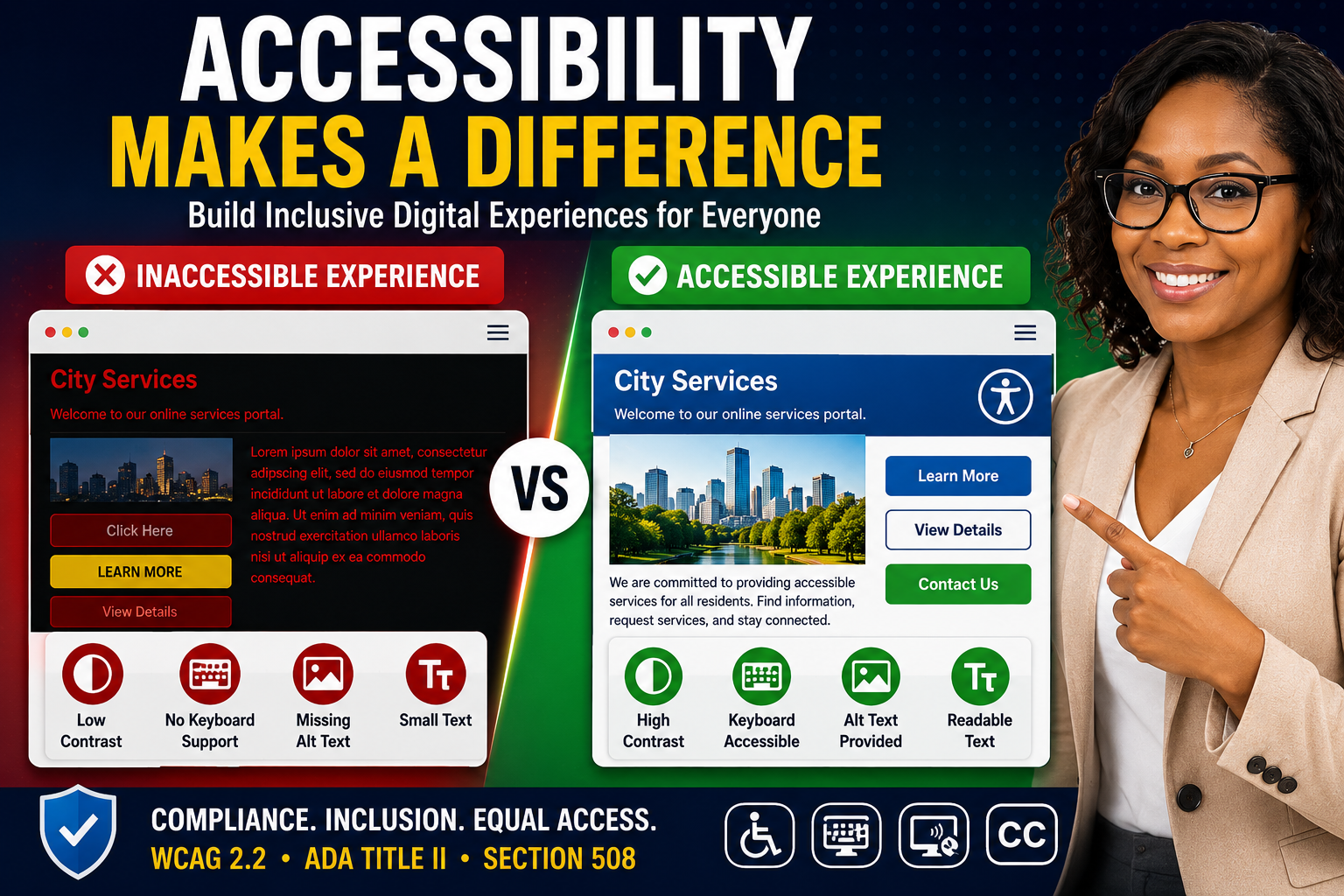
Digital accessibility is no longer simply a technical issue handled by developers or QA teams. In 2026, organizations are beginning to recognize that accessibility requires governance, planning, accountability, and long-term strategy.
As ADA Title II regulations continue reshaping expectations for state and local governments, many agencies and organizations are moving toward more mature accessibility programs that go far beyond fixing isolated website errors.
One of the biggest changes happening today is the shift from reactive accessibility to proactive accessibility governance.
For years, many organizations approached accessibility only after receiving complaints, lawsuits, or audit findings. Accessibility work was often treated as a temporary remediation project instead of an ongoing operational priority.
That approach is changing quickly.
Federal agencies, universities, healthcare systems, and public institutions are now building formal accessibility governance programs to create sustainable accessibility practices across their organizations.
These governance programs often include:
- accessibility policies
- procurement requirements
- VPAT review processes
- accessibility testing standards
- document accessibility procedures
- accessibility training
- monitoring and reporting systems
The reason for this shift is simple.
Accessibility affects nearly every part of an organization’s digital environment.
Websites, mobile applications, PDFs, forms, videos, dashboards, learning platforms, HR systems, customer portals, and procurement platforms must all be accessible to individuals with disabilities.
Organizations are realizing that accessibility cannot be managed effectively without structure and accountability.
Another major trend driving accessibility governance is procurement compliance.
Government agencies and educational institutions increasingly require vendors to provide VPATs and accessibility documentation before contracts are approved.
This means vendors are now expected to demonstrate accessibility maturity before selling products or services to public-sector clients.
As a result, accessibility is becoming part of business development, vendor management, and procurement decision-making.
Organizations that fail to prioritize accessibility may face reputational risk, legal exposure, procurement delays, or lost business opportunities.
We are also seeing increased attention on manual accessibility testing.
While automated testing tools continue improving, accessibility experts repeatedly emphasize that automation alone cannot fully evaluate user experiences.
Automated tools may identify missing alt text or color contrast failures, but they often miss issues involving:
- keyboard navigation
- screen reader usability
- focus order
- meaningful labels
- accessible error handling
- dynamic content behavior
- cognitive usability challenges
Because of this, organizations are investing more in human-centered accessibility evaluations and usability testing.
Another growing area of concern involves public dashboards and data visualization tools.
Recent accessibility research shows that many dashboards remain difficult for blind and low-vision users to navigate. Hover-based interactions, inaccessible charts, poor labeling, and missing data alternatives continue creating barriers for users who rely on assistive technologies.
This is especially important for government agencies that provide public services and information online.
Accessibility is also becoming increasingly connected to inclusive user experience design.
Organizations are beginning to understand that accessibility improvements often benefit everyone, not just individuals with disabilities.
Clear navigation, readable text, captions, keyboard support, mobile usability, and simplified layouts improve usability across diverse audiences and devices.
The future of accessibility is moving toward integration instead of isolation.
Rather than treating accessibility as a separate initiative, organizations are embedding accessibility into procurement, development, content creation, QA testing, design systems, and governance frameworks.
The organizations that invest in accessibility governance now will be better prepared for evolving regulations, changing standards, and growing user expectations in the years ahead.

